


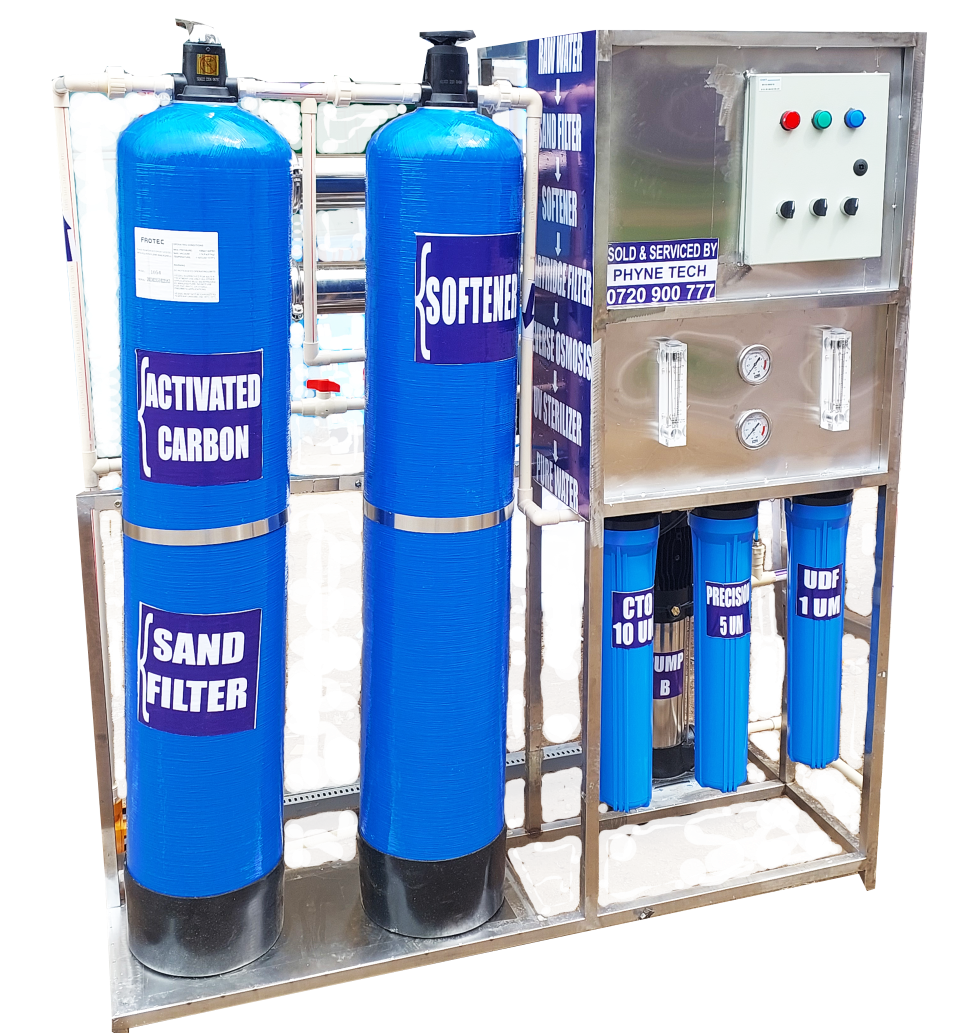
Reverse Osmosis Water Purifiers
KSh230,000.00
Features of our Reverse Osmosis Water Purifiers
- Comes with 3 cartridge filters
- Comes with 4 reverse osmosis membrane
- Comes with a high-pressure pump
- Comes with a reverse osmosis membrane
- Comes with a UV sterilizer– to kill bacteria
- Comes with antiscalant dosing pump
- Comes with Carbon filtration
- Comes with sand filtration
- Comes with Softener- resin for ion exchange
Description
Reverse Osmosis Water Purifiers
When it comes to maintaining the purity and safety of your drinking water, Aquatech reverse osmosis water purifiers are an excellent alternative. Our RO purifiers are intended to purify tap water, bowser water, and borehole water.
These purifiers are extremely durable, efficient and reliable, capable of converting practically any sort of water into clean, safe drinking water, regardless of its initial state or source. The innovative filtration system successfully removes impurities, giving you and your family constant access to high-quality water.
Our reverse osmosis systems function by pushing water through a semi-permeable membrane, which removes contaminants like heavy metals, chemicals, and microbes. This process not only improves the taste and odour of your water, but it also gives you peace of mind knowing that it is free of contaminants.
Our RO purifiers are capable of purifying water from municipal supplies, water bowsers, and boreholes. They are designed to last and require little maintenance, making them a dependable and cost-effective solution for your water filtration requirements.
Invest in our reverse osmosis water purifiers immediately to see the difference in water quality. Your health and well-being deserve nothing but the finest.
How does a reverse osmosis systems work?
 A reverse osmosis water purifiers uses a prefilter to remove sediment and chlorine from water before forcing it through a semipermeable membrane to remove dissolved solids. Water exits the RO membrane and flows through a postfilter to polish the drinking water before entering a designated tap. Reverse osmosis systems have different stages based on the quantity of prefilters and postfilters.
Stages of RO systems
Although the RO membrane is the main focus of a reverse osmosis system, other types of filtration are often used. RO systems consist of three, four, or five stages of filtration.
Aside from the RO membrane, every reverse osmosis water system includes a sediment filter and a carbon filter. The filters are classified as prefilters or postfilters based on whether water travels through them before or after passing through the membrane.
Each type of reverse osmosis water purifier contains one or more of the following filters:
- Sediment filter: Reduces particles like dirt, dust, and rust.
- Carbon filter: Reduces volatile organic compounds (VOCs), chlorine, and other contaminants that give water a bad taste or odor.
- Semi-permeable membrane: Removes up to 98% of total dissolved solids (TDS).
Purification stages of a reverse osmosis water purifiers:
- Prefiltration is the initial step in a RO system. Prefiltration usually consists of a carbon filter and a sediment filter to remove sediment and chlorine that could clog or harm the RO membrane.
- Water passes across a reverse osmosis membrane, which removes dissolved particles that are too tiny to view with an electron microscope.
- After filtration, water is stored in a tank until needed. A reverse osmosis system filters water until the storage tank is full, at which point it shuts off.
- When you turn on the drinking water tap, water from the storage tank goes through a postfilter to clean it before reaching the tap.
8 things to consider when buying a reverse osmosis system
- Water supply
The water that comes into your home feeds the reverse osmosis system. City water, or municipally treated water, is generally free of chemicals and germs, although it may contain inorganic dissolved solids, which a RO system is intended to decrease. Aside from dissolved solids, private well water may contain dangerous microorganisms and pollutants.
Reverse osmosis systems may treat both city and well water, provided that the well water has been cleaned to remove germs and debris that could clog the membrane. If your well water is tainted with heavy elements such as arsenic, you may need a UV system to disinfect it once it leaves the storage tank.
- Water demand
Consider how much water you and your family will consume. Nutritionists recommend that everyone drink half of their body weight in ounces every day. So, if you weigh 72 kgs, you should drink 2.3 liters of water per day. You must also account for the amount of water consumed in ice machines, refrigerators, and other equipment. Mayo Clinic on their website recommend about 15.5 cups (3.7 liters) of fluids a day for men. About 11.5 cups (2.7 liters) of fluids a day for women. On the other hand Havard University health say that there’s no one size fits all because it depends with other factors like other fluids you take, age, health condition, climatic conditions, exercise or lack of it etc.
- Water Pressure
Reverse osmosis uses water pressure to drive clean water through a membrane. If your domestic water pressure is less than 40 psi, you’ll need to utilise a RO booster pump to enhance the pressure for reverse osmosis.
If you have a well water supply, ensure sure your tank’s water pressure is high enough for a RO system to function. A high concentration of dissolved solids in water increases the amount of pressure required by the RO system to generate clean water.
A residential reverse osmosis system is point-of-use, which means you install it where you need RO water. Most RO systems are installed immediately beneath the sink. Whole-house reverse osmosis systems are less commonly utilised since they require a big storage tank and a booster pump to maintain appropriate pressure to distribute water to every location in the home.
- RO Style

Reverse osmosis systems come in three cartridge styles: quick-change, drop-in, and standard. Your filter style preference is determined by whether you choose ease of maintenance, cheap maintenance costs, or minimal environmental impact.
Quick-change cartridges are the simplest to maintain, but also the most expensive and environmentally unfriendly.
Quick-change filters may be easily replaced. Simply twist and take the filter out. Then, spin the new filter in the other way to replace the old one. However, the ease of maintenance comes with a high cost, and the filter cartridges are composed of plastic, which is squandered whenever an old filter is thrown.
Drop-in and standard cartridges are more difficult to change, but they are also the most inexpensive and environmentally beneficial.
To change a drop-in or standard filter, unscrew the housing, discard the filter cartridge, insert a new cartridge, and reinstall the housing. Standard filters can be replaced with compatible cartridges, while drop-in systems need exact replacements.
Reverse osmosis systems are also available in several stages, typically three, four, or five, depending on the number of prefilters and postfilters used. The RO membrane handles the majority of the work in removing dissolved solids, but additional prefilters and postfilters can polish, remineralize, and remove more chlorine and sediment. The membrane eventually wears out, but prefilters provide an initial pass-through filter material, which helps to extend membrane life.
- Budget
When budgeting for a reverse osmosis system, you need consider various factors: How much does the system cost? How much would the installation cost, especially if you employ someone? How much does ongoing maintenance cost? These considerations may influence the RO system you use, or if you use one at all.
The cost of a reverse osmosis system varies based on whether you need one beneath your sink or for the entire house, as well as the number of additional components required. Whole-house RO systems are significantly more expensive and sophisticated. Under-sink RO systems are normally cheaper than their commercial counterparts and there are different types at different prices, depending on the type. The cost rises if the system contains a booster pump, permeate pump, storage tank, or pretreatment.
Any RO system installation is an investment that requires ongoing care, including as filter and membrane replacements. The cost and frequency of replacements are determined by the style of your RO system. Generally, the RO membrane should be replaced every two years, and the filters every six months to a year. With proper maintenance, the reverse osmosis system can run for 20 years or more.
Factors that influence the cost of an RO system:
- Type of system
- Pretreatment
- Installation cost
- Maintenance cost
- Additional components
- Ease of Installation
Most under-sink reverse osmosis systems are simple to install. However, because an under-sink RO system has a specialised tap, you may need to drill a hole in your countertop. If you are not comfortable completing this job yourself, you may need the help of a plumber, a handy friend, or a family member.
To keep bad drain water from leaking back into clean drinking water, reverse osmosis systems require a dedicated tap and drain connection. An RO system connects the drain and water lines. The plumbing code specifies that cross-connections have an air gap tap that allows drain water to pass through without returning to clean water.
Before installing a whole-house reverse osmosis system, consult a water consultant to ensure that there is no simpler, similarly effective option and that suitable pretreatment is used based on your water circumstances.
- Efficiency
A reverse osmosis system is not the most effective filter. Reverse osmosis removes pollutants and sends them to the drain with a large amount of water. However, this water is not completely wasted because it is used to transport pollutants and produce drinkable water.
Standard water filters collect impurities on their surfaces, but the RO membrane traps them and transports them down the drain. Adding a permeate pump to your RO system increases it efficiency by 85%. The permeate pump converts wastewater into electricity and sends clean water to the storage tank. The most environmentally friendly RO systems contain a permeate pump or allow you to install one.
- Remineralization
Reverse osmosis removes dissolved particles from water while also lowering alkalinity or pH. The decreased pH acidifies the water slightly. Acid water is corrosive; however, adding an acid neutralising filter, such as a calcite filter or an alkaline water filter, raises the pH and adds mineral flavour. The Aptera filter dissolves calcium.
 Aquatech is a one stop shop for all your reverse osmosis water purifiers needs- Contact us today to acquire one
Are you in need of a robust, high quality, efficient and affordable reverse osmosis water purification machine? No need to look further. We are experts in designing and building high-quality KEBS standards reverse osmosis water purifiers in Kenya. Get in touch with us today to acquire one. Whether you need it for commercial use or domestic use we have you covered.



Reviews
There are no reviews yet.